News Detail
Hashi Smart Latest Updates
2026-07-21 · 5 views
Let us be real. Cleaning a cat water fountain is nobody's favorite chore. You know it needs to happen. You know the slimy biofilm is building up. You know your cat deserves fresh clean water. But every time you think about disassembling the thing, scrubbing every corner, and putting it all back together, something inside you says maybe next week.
That is exactly why dishwasher safe cat fountains are such a big deal. The promise of tossing the parts into a machine and walking away sounds almost too good to be true. And honestly, if you do it wrong, it kind of is. The dishwasher can absolutely clean a cat water fountain properly and efficiently. But there is a right way and a wrong way to go about it.
Here is everything you need to know.
Before you load anything, you need to know which parts of your fountain are dishwasher safe and which ones are not. Not every fountain handles a dishwasher cycle the same way and getting this wrong can crack a lid, warp a tray, or kill a pump.
Here is the general breakdown.
Usually dishwasher safe. Stainless steel basins and lids. Ceramic basins and lids. Some BPA free plastic trays and covers depending on the specific plastic grade.
Never dishwasher safe. The pump. The power cord or charging port. The filter cartridge. Any electronic component whatsoever.
Check the manual. Some plastic components are top-rack safe only. Some ceramic pieces with decorative glaze need lower temperature cycles. When in doubt, the manufacturer instructions are your best friend. If you threw those away, most brands have them on their website.
If you own a stainless steel cat fountain, you are in luck. Stainless steel handles dishwasher cycles without any issues. No warping, no discoloration, no degradation. It is one of the many reasons vets and experienced cat owners prefer this material.
Follow this routine and you will have a sparkling clean fountain in under an hour with about two minutes of actual hands-on effort.
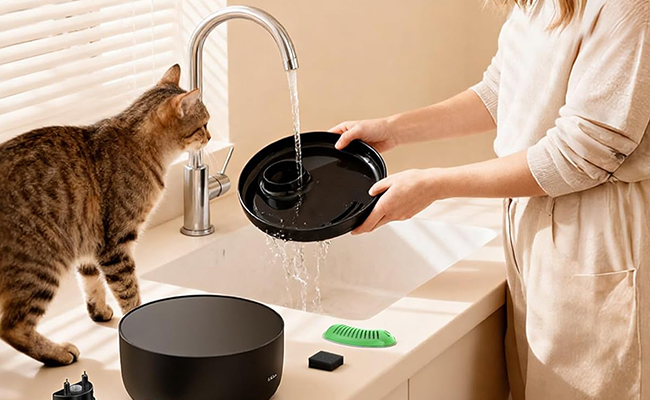
Turn off the fountain and unplug it or remove it from the charging base if it is rechargeable. Take the whole thing apart. Lift off the lid or drinking tray. Remove the basin. Pop out the pump. Take out the filter.
Lay all the pieces on the counter so you can see exactly what you are working with. This takes maybe thirty seconds on a well-designed fountain. If your current model requires tools or a YouTube tutorial to take apart, that is a design problem worth thinking about for your next purchase.
Before loading anything into the dishwasher, give each piece a quick rinse under the tap. You want to remove cat hair, food particles, and any loose gunk. The dishwasher handles the deep cleaning but it works best when it is not fighting through a layer of fur first.
Pay extra attention to the inside of the basin and any crevices where debris tends to collect. A quick thirty-second rinse saves you from finding stuck-on residue after the cycle finishes.
Place the basin, lid, and drinking tray on the top rack of the dishwasher. The top rack is further from the heating element at the bottom, which means gentler heat exposure. This is important for plastic parts that could warp under intense direct heat.
If you have a stainless steel basin, the bottom rack is fine too since metal handles heat without any problem. But keeping everything on the top rack is a safe default for mixed material loads.
Make sure nothing is nested too tightly. Water and detergent need to reach every surface. Prop items at an angle so water does not pool inside concave pieces.
This is the part most people get wrong. The heated dry cycle at the end of a dishwasher run can expose plastic components to temperatures they were not designed for. It can cause warping, micro-cracking, or surface cloudiness.
Use a normal wash cycle with regular detergent. When the cycle ends, open the door and let the parts air dry naturally. Pull them out after ten minutes and hand dry with a clean towel. The whole process takes seconds of actual effort.
While the dishwasher is running, this is your chance to deal with the one part that cannot go in the machine. The pump.
Remove the pump casing. Take out the impeller. Rinse everything under warm running water. Use a small brush or even an old toothbrush to scrub any buildup inside the housing and around the impeller blades.
Once a month, soak the pump parts in a solution of one part white vinegar to three parts warm water for about fifteen minutes. This dissolves mineral deposits that regular rinsing cannot touch. Rinse thoroughly with clean water afterward and let everything air dry before reassembling.
Never put an old filter back into a freshly cleaned fountain. This is the perfect time to swap in a fresh one. Mark the date so you know when the next replacement is due.
Once all the parts are dry, reassemble the fountain. Fill it with fresh water. Plug it in or place it on the charging base. Turn it on and make sure the water is flowing properly.
That is it. The whole process from disassembly to reassembly takes about two minutes of active work. The dishwasher does the heavy lifting.
A full dishwasher clean once a week is ideal for most households. If you have multiple cats or heavy shedders, twice a week is not overkill.
Between dishwasher cycles, a quick daily rinse of the basin keeps things fresh. Just dump the old water, rinse the surface, wipe away any visible hair or debris, and refill. This takes less than a minute and dramatically extends the time between deep cleans.
The filter should be replaced every two to four weeks regardless of how often you run the dishwasher. Filters and dishwashers solve different problems. The dishwasher cleans surfaces. The filter purifies the water during circulation.
A few things that damage fountains or leave them less clean than you would expect.
Putting the pump in the dishwasher. This is the single most common mistake. Water pressure inside a dishwasher can force moisture into the motor housing and destroy the electronics. Always hand wash the pump.
Using harsh detergents. Standard dishwasher detergent is fine. Avoid anything with bleach or heavy fragrances. Residual chemicals can transfer into the water and put your cat off from drinking.
Skipping the pre-rinse. Cat hair and loose debris can clog the dishwasher filter or redeposit onto your fountain parts during the cycle. A quick rinse before loading prevents this.
Using the heated dry cycle. Warped plastic and clouded surfaces are the result. Air dry only.
Reassembling while still damp. Trapped moisture inside assembled parts encourages mold and bacteria growth. Let everything dry completely before putting it back together.
A well-designed cat water fountain makes every one of these steps easier. Tool-free disassembly, dishwasher safe materials, and an accessible pump housing are not luxury features. They are the difference between a fountain that stays clean and one that ends up in the back of a closet.
Can I put my entire cat water fountain in the dishwasher? No. The basin, lid, and drinking tray are usually dishwasher safe depending on the material. The pump, filter, and any electronic components must always be cleaned by hand. Check your specific model's instructions to confirm which parts are dishwasher safe.
What dishwasher setting should I use? A normal cycle with regular detergent works best. Avoid heavy-duty or sanitize cycles that use extremely high temperatures. Skip the heated dry option and let parts air dry instead.
Is it safe to use dishwasher detergent on a cat fountain? Standard unscented dishwasher detergent is perfectly safe. Avoid products with bleach, strong fragrances, or added rinse agents as residue could transfer into the water and discourage your cat from drinking.
How often should I dishwasher clean my cat fountain? Once a week is the sweet spot for most households. Daily quick rinses between deep cleans help maintain freshness. Replace the filter every two to four weeks on a separate schedule.
Will the dishwasher damage my stainless steel fountain? No. Stainless steel handles dishwasher cycles without any issues. It does not warp, discolor, or degrade from heat or detergent exposure. It is one of the most dishwasher-friendly materials available.
My plastic fountain turned cloudy after dishwashing. What happened? This is usually caused by the heated dry cycle exposing the plastic to temperatures beyond its tolerance. Switch to air drying and the cloudiness should not return on future cycles. If the plastic is already warped, it may be time to consider upgrading to a stainless steel or ceramic model.
We are a professional pet product factory specializing in cat water fountains designed for real life. Every product in our range features tool-free disassembly, dishwasher safe components, and accessible pump housings that make weekly cleaning something you can actually stick with.
Our lineup includes stainless steel fountains, ceramic fountains, and BPA free plastic options across multiple price points. We offer full ODM and OEM services from initial concept and design through material selection, mold development, filtration engineering, logo printing, packaging, and quality control.
We work with pet product sellers, distributors, and brand owners worldwide. Samples are ready to ship so you can test the build quality and cleaning ease for yourself.
Want to offer your customers a fountain they will actually keep clean? Send us your specifications, target price, or product ideas. Our team will respond within 24 hours with a proposal tailored to your market.
Contact us for wholesale pricing and customization options

 English
  Español
 Русский
 العربية